THANK YOU TO OUR STUDENT LEADERSHIP COMMITTEE AND OUR FACULTY ADVISORS FOR MAKING THIS HAPPENFACULTY ADVISORS
AVI MCCLELLAND-COHEN
LAURA FLEMING
NORA MURPHYSTUDENT LEADERSHIP COMMITTEE
AUDREY MA
SABREEN EL-AMIN
OLIVIA ZEE
RYAN KIM
MICHELLE XU
WILLIAM PAN
ALEXANDRA TAN
ELLEN CHEUNG
Hello!
To Where?
Schedule
8:30 AM
Arrivals to campus and registration9:00 AM TO 10:30 AM
Opening Plenary10:30 AM TO 0:45 AM
Break10:45 AM TO 11:45 AM
Dialogue 1 and Educator Discussion11:45 AM TO 1:00 PM
Lunch + Optional Campus Tours1:00 PM TO 1.30 PM
Breakout Presentation Session 11:30 PM TO 2:00 PM
Breakout Presentation Session 22:00 PM TO 3:00 PM
Dialogue 23:00 PM TO 3:30 PM
Break3:30 PM TO 4:15PM
Community Action Planning In School Groups4:15 PM TO 5.00 PM
Closing Session
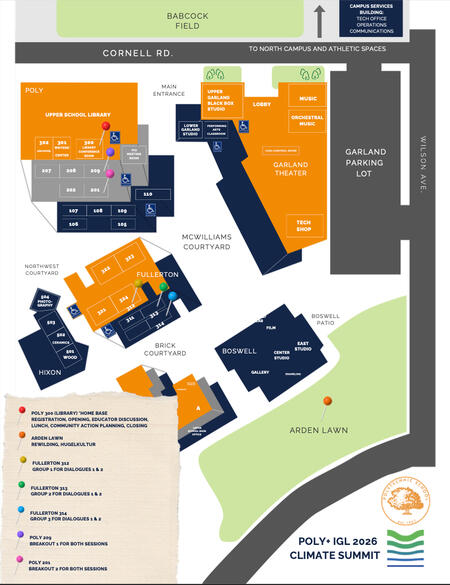
Map
Panelist Information
Drew Shula is a social entrepreneur and environmentalist. He is Founder & CEO of Verdical Group, a nationally leading sustainability consulting firm working on green building projects with visionary institutions like NASA, Google, Johnson & Johnson, LAX, Meta, and Apple. Under his leadership, Verdical Group was named to the Inc. 5000 list of America’s fastest-growing private companies in 2025 and was a Finalist for Small Business of the Year from the U.S. Chamber of Commerce in Washington DC in 2022. Drew has been featured in USA Today, The Washington Post, Forbes, Metropolis Magazine, USGBC+ Magazine, and Architectural Record Magazine.Bonnie Wongtrakool is an investment executive with over 25 years of experience in sustainable finance, corporate governance, and capital markets. She is currently Global Head of Sustainable Investments and Portfolio Manager at Franklin Templeton's largest fixed-income subsidiary, where she leads ESG research, engagement, strategies, and portfolios. Bonnie is a CFA Charterholder and a graduate of Harvard College and Harvard Law School. She also serves as Trustee and Finance & Investment Committee Chair of the Pasadena Playhouse and sits on the Pasadena Community Foundation Investment Committee.Wesley Reutimann is a Pasadena resident, Pasadena100 volunteer, and co-founder of Active San Gabriel Valley (ActiveSGV) and the Pasadena Complete Streets Coalition (PasadenaCSC). He has almost two decades of experience in the non-profit sector with community-based, government, and educational institutions. Wesley's areas of focus include health policy, sustainable mobility, and active communities.
Dialogue Assignments
SESSION 1: 10:45 AM to 11:45 AMGROUP A
Tekle Skiles-Januta (WS)
Larkin Murray (WS)
Carter Morrell (Prep)
Deivis Danovitch (Geffen)
Quinn O'Malley (Seq)
Isha Agrawal (Seq)
Jujube Hutt
Eila Chan
Isabella Heredia
Finn Thompson
Vanessa Lin
Livvy Zee
Uriel ResendizGROUP B
Jennifer Sawyer (WS)
Katelyn Liu (Prep)
Xizi Xia (Geffen)
Greta Bailey (Seq)
Amélie Barajas (Seq)
Aleks Simpson (York)
Carthan Connolly
Melissa Ponce
Clara Carmichael
William Pan
Michelle Xu
Audrey Ma
Sophie TanGROUP C
Revecca Fromer (WS)
Jacqueline Chow (Prep)
Ever Agbowu (Geffen)
Liliana Abraham (Seq)
Luca DiMassa (Seq)
Amelie Salette
Marise Saiki
Dylan Truong
AB Shorter
Lucas Hong
Ellie Cheung
Aidan ShihSESSION 2: 2:00 PM to 3:00 PMGROUP A
Jennifer Sawyer (WS)
Larkin Murray (WS)
Carter Morrell (Prep)
Ever Agbowu (Geffen)
Luca DiMassa (Seq)
Quinn O'Malley (Seq)
Amelie Salette
William Pan
Isabella Heredia
Vanessa Lin
Clara Carmichael
William Pan
Aidan ShihGROUP B
Revecca Fromer (WS)
Jacqueline Chow (Prep)
Deivis Danovitch (Geffen)
Liliana Abraham (Seq)
Greta Bailey (Seq)
Sophie Tan
Marise Saiki
Melissa Ponce
Ryan Kim
Lucas Hong
Ellie Cheung
Carthan Connolly
Sabreen El-AminGROUP C
Tekle Skiles-Januta (WS)
Katelyn Liu (Prep)
Xizi Xia (Geffen)
Amélie Barajas (Seq)
Isha Agrawal (Seq)
Aleks Simpson (York)
Eila Chan
Dylan Truong
AB Shorter
Finn Thompson
Alexandra Tan
Jujube Hutt
Uriel Resendiz
Breakout Options
SESSION 1 (1:00 PM to 1:30 PM)Breakout Option A (Poly 209)
Exploring California Water Management: Sustainability, Innovation, and AwarenessBreakout Option B (Poly 201)
Elbow Deep: Leadership as a Compost CzarSESSION 2 (1:30 PM to 2:00 PM)Breakout Option A (Poly 209)
Crafting Thoughtful Outdoor Spaces With Natives and SustainabilityBreakout Option B (Poly 201)
Engaging Communities Through Citizen Science: Education, Equity, and Environmental StewardshipExploring California Water Management: Sustainability, Innovation, and AwarenessThis ongoing interdisciplinary project investigates the key drivers of sustainability and water management in California. One aspect of this research was the creation of a ‘DIY’ aquaponics project. Although more sustainable and often more efficient, aquaponics systems are overshadowed by commercial farming practices or a traditional home garden. Further research conducted consisted of an exploration into local water management practices in Monterey county. Although this looked at a small area that is on a separate water plan than a large area of the state, the Salinas Valley is known as the “Salad Bowl” of the United States and its complex water infrastructure can be used to show how important sustainability is in a small, self-dependent area with a high demand for water consumption. Further research could include a GIS chart or educational blog that could be a trove of easily accessible information aimed to make data and insights on California’s water systems more accessible to the public, supporting broader awareness of water’s critical role in environmental sustainability.Elbow Deep: Leadership as a Compost CzarMaking a community more sustainable often requires changing people’s habits. Changing habits takes work. But people are busy, and their priorities for individual action don’t always line up. As environmentalist student leaders, how do we build systems that allow lots of people to participate in improving their own impact?That road is lined with traps: careless classmates and stubborn administrators, tight regulations and ethical questions of responsibility. In this presentation, I’ll discuss how to make noise, gain support, and reshape real-life routines, working persistently until a green policy has truly been adopted community-wide. I’ll share my experience starting a super successful student-run program to collect compostable waste at my high school, Geffen Academy at UCLA. And I’ll pass on the biggest lesson I’ve learned: how targeted student effort can help an entire school community function more sustainably, carried forward by environment-conscious hope and momentum.Crafting Thoughtful Outdoor Spaces With Natives and SustainabilityHow can student activists drive real, lasting change at their own schools? What does rewilding have to do with fighting climate change?This presentation tells the story of Poly's rewilding efforts over the past two years — a collaborative, campus-wide movement that has transformed natural spaces into vibrant habitats for the local ecosystem. It started with a spark: a talk by Leigh Adams to our sustainability clubs that reframed how we thought about the land around us. From there, student advocates pushed to implement rewilding on campus. That curricular foothold opened doors for further rewilding efforts like hügelkultur and native plantings.Along the way, we've seen the importance of native plants — they support local biodiversity, build soil health, and contribute meaningfully to regional climate resilience at a moment when biodiversity loss is accelerating globally.Attendees will leave with a clearer picture of how to move from inspiration to systemic change — working with community partners, administrators, and fellow students to make sustainability not just a value, but a practice embedded in school life.Engaging Communities Through Citizen Science: Education, Equity, and Environmental StewardshipCitizen science has the power to turn everyday people into environmental stewards by transforming curiosity into data, and data into action. I will share how community-based citizen science initiatives deepen connections to local ecosystems while promoting environmental and climate equity through accessible education.Drawing from my Eagle Scout project at Crescent Farm, which integrated iNaturalist to document biodiversity, I will discuss how engaging community members in scientific observation lowers barriers to participation, builds climate literacy, and fosters ecological awareness and a sense of place. I will highlight my work through the Wolves for Wildlife club, where we educate students about native plants and wildlife and organize hands-on restoration days. Through these experiences, I have seen how education shapes who feels empowered to care about climate issues and who feels excluded.Students will leave with concrete ideas for using citizen science to engage their communities and create meaningful, inclusive environmental action at the local level.
Resources